Signed in as:
filler@godaddy.com
The Christina Lake Stewardship Society is a non-profit charitable organization that was established in January of 2001 (Committee Est. 1994). Our goal is to preserve and protect the quality and health of the Christina Lake watershed. Over the years the Society has been involved in several projects that are focused on environmental monitoring and education.
Our office and interpretative gallery is located inside the Christina Lake Welcome Centre where visitors can access educational resources pertaining to our watershed.


From September to October staff and volunteers conducted kokanee enumerations every Wednesday and Saturday. Counts take place in both Sutherland and Sandner Creeks. This project has been conducted annually, and the collected data has been compiled each year. The project helps establish a baseline understanding of the population of creek
From September to October staff and volunteers conducted kokanee enumerations every Wednesday and Saturday. Counts take place in both Sutherland and Sandner Creeks. This project has been conducted annually, and the collected data has been compiled each year. The project helps establish a baseline understanding of the population of creek-spawning kokanee in Christina Lake. As a key indicator species, the kokanee salmon also provides valuable insights into the overall health of Christina Lake.
Sandner Creek remains the dominant spawning tributary for Christina Lake’s stream-spawning kokanee. Sutherland Creek supports a much smaller and declining run, with only a single kokanee observed in 2025. The most recent data shows a total of 3,680 kokanee across both creeks, reflecting a decrease from the previous four years and continuing the downward trend following the peak observed in 2020. These fluctuations are typical of kokanee population cycles but may also be influenced by environmental conditions such as stream flow, temperature, and lake productivity. Ongoing monitoring will be important to track population health and to assess the factors influencing spawning success within the Christina Lake watershed
Through a partnership with the British Columbia Lake Stewardship Society and the Province of British Columbia, CLSS conducts water quality monitoring from May through October. During each sampling session, temperature, dissolved oxygen, and Secchi depth readings are collected to assess water clarity and overall lake health. The data is
Through a partnership with the British Columbia Lake Stewardship Society and the Province of British Columbia, CLSS conducts water quality monitoring from May through October. During each sampling session, temperature, dissolved oxygen, and Secchi depth readings are collected to assess water clarity and overall lake health. The data is sent to a provincial biologist, who compiles the results into a publicly accessible database. Samples are taken biweekly at two sites shown here on the map—the north basin, representing the deeper section of the lake, and the south basin, the shallower area. Sampling both areas provides a complete understanding of the lake’s condition: deep sites reveal long-term water quality and oxygen trends, while shallow sites capture localized impacts from runoff, recreation, and shoreline activity. For a complete look at the lake’s overall quality and health, please visit the B.C. Lake Monitoring Network.
Christina Lake Stewardship Society conducts biweekly monitoring for invasive zebra and quagga mussels from May to October at two key locations: just off the docks at Texas Creek Boat Launch and Schulli Resort. These sites are high-traffic areas where boats and recreational activity make the introduction of invasive mussels more likely. Sa
Christina Lake Stewardship Society conducts biweekly monitoring for invasive zebra and quagga mussels from May to October at two key locations: just off the docks at Texas Creek Boat Launch and Schulli Resort. These sites are high-traffic areas where boats and recreational activity make the introduction of invasive mussels more likely. Sampling from a boat allows us to efficiently collect veligers, the free-floating larval stage, to detect the earliest signs of mussels in the lake. The water samples we collect are sent to Limno Labs in Vancouver, where trained technicians examine them under a microscope to determine whether veligers are present. Veligers are the larval, free-floating stage of the zebra and quagga mussels. They hatch from eggs after fertilization and are microscopic, usually less than 1 millimeter in size, making them invisible to the naked eye. Unlike adult mussels that attach firmly to surfaces, veligers drift in the water carried by currents, boats, and other equipment, which makes them the primary stage for the spread of invasive mussels between lakes and waterbodies. During this planktonic stage, veligers feed on microscopic algae and nutrients and remain in the water for days to weeks before settling onto surfaces like docks, boats, or rocks, where they grow into juveniles and eventually adults. Because they are the first stage of potential infestation, monitoring for veligers is critical for early detection and rapid response efforts, as catching them at this stage offers the best chance to prevent mussels from establishing and causing ecological and economic damage.
The Christina Lake Stewardship Society (CLSS), in partnership with the Boundary Invasive Species Society (BISS), is undertaking a turtle monitoring project focused on both the native western painted turtle and the non-native red-eared slider. The western painted turtle is recognized as a species at risk in our area, while red-eared slide
The Christina Lake Stewardship Society (CLSS), in partnership with the Boundary Invasive Species Society (BISS), is undertaking a turtle monitoring project focused on both the native western painted turtle and the non-native red-eared slider. The western painted turtle is recognized as a species at risk in our area, while red-eared sliders, an introduced species, can outcompete native turtles for basking sites, nesting habitat, and food resources. Their presence poses a significant threat to the long-term survival of our native population. Through this project, CLSS and BISS are tracking sightings of both species to establish baseline population estimates, identify high-use areas for basking, nesting, and movement, and monitor population trends over time to evaluate whether red-eared sliders are displacing or negatively affecting western painted turtles. We are also hoping to determine whether any hatchlings emerge from their nests in the fall versus overwintering and emerging in the spring, which provides insight into ideal timing for hatchling survival.
Our youth programs are tailored to different age groups, with dedicated programming for children ages 5 and under, ages 6–12, and high school students. We also offer environmental education presentations and hands-on activities for schools, daycares, homeschool groups, libraries, and other community organizations.
Little Stewards is our
Our youth programs are tailored to different age groups, with dedicated programming for children ages 5 and under, ages 6–12, and high school students. We also offer environmental education presentations and hands-on activities for schools, daycares, homeschool groups, libraries, and other community organizations.
Little Stewards is our program for children ages 5 and under. Early exposure to nature-based learning helps children develop a sense of wonder and connection to the natural world, fostering empathy, respect, and care for all living things. These early experiences lay the foundation for lifelong environmental awareness, as children who build positive connections with nature are more likely to carry those values into adulthood.
For children ages 6–12, we offer engaging environmental education through local schools, homeschool groups, and community organizations. During July and August, our popular summer youth program welcomes both local families and visitors for hands-on activities and outdoor adventures that encourage exploration and discovery. At this age, children are naturally curious and ready to explore topics such as conservation, wildlife, water quality, ecosystems, and environmental stewardship in a fun and engaging way.
Our high school programming provides students with opportunities to explore environmental issues in greater depth through presentations, field experiences, and stewardship activities. These programs encourage critical thinking, build practical skills, and inspire the next generation of environmental leaders by connecting classroom learning with real-world conservation initiatives in the Christina Lake watershed.
Lake Clean Up Day continues to be one of Christina Lake Stewardship Society’s most popular and well-attended events. Our community volunteers contribute their time and energy to removing garbage from our parks, residential areas, highways, and trails. The goal is not only to make the area look better, but also to protect wildlife, improve
Lake Clean Up Day continues to be one of Christina Lake Stewardship Society’s most popular and well-attended events. Our community volunteers contribute their time and energy to removing garbage from our parks, residential areas, highways, and trails. The goal is not only to make the area look better, but also to protect wildlife, improve water quality, and raise awareness about keeping the watershed healthy. This event has taken place for over 20 years. We are grateful for all our volunteers that help keep our lake clean!
Our Derelict Dock Program continues to be an important and ongoing initiative that helps protect the health and beauty of Christina Lake. Abandoned and deteriorating docks can release plastics, Styrofoam, and other harmful materials into the water, which can negatively affect fish, wildlife, and overall water quality. By removing these
Our Derelict Dock Program continues to be an important and ongoing initiative that helps protect the health and beauty of Christina Lake. Abandoned and deteriorating docks can release plastics, Styrofoam, and other harmful materials into the water, which can negatively affect fish, wildlife, and overall water quality. By removing these aging structures, we help reduce pollution, protect shoreline habitat, and preserve the natural character of the lake for years to come. If you have dock that needs to be removed, get in touch with us!
The Fish in Schools Program also known as (FinS), was created by the Okanagan Nation Alliance (ONA), and aims to inspire people to become future advocates for salmon and their habitats. CLSS has been participating in the program since 2019, each year we host a tank with 100 sockeye salmon, which has become a popular feature in our inter
The Fish in Schools Program also known as (FinS), was created by the Okanagan Nation Alliance (ONA), and aims to inspire people to become future advocates for salmon and their habitats. CLSS has been participating in the program since 2019, each year we host a tank with 100 sockeye salmon, which has become a popular feature in our interpretive gallery. This provides visitors with a unique opportunity to observe the early stages of a salmon’s life—an experience that many people may never have. Each spring, CLSS is honored to take part in the Annual Sockeye Salmon Release Ceremony organized by the ONA. Held every May on the Columbia River in Castlegar, the event celebrates the release of the salmon we’ve cared for over the past five months.
Our interpretive gallery and office are located in the Christina Lake Welcome Centre, a popular destination for both locals and visitors. The gallery features a variety of interactive displays and activities designed to make learning enjoyable, along with informative posters and wildlife artifacts. This space offers an engaging environm
Our interpretive gallery and office are located in the Christina Lake Welcome Centre, a popular destination for both locals and visitors. The gallery features a variety of interactive displays and activities designed to make learning enjoyable, along with informative posters and wildlife artifacts. This space offers an engaging environment for people of all ages to explore local wildlife and learn about stewardship efforts in our region.
We have successfully installed six bat boxes around Christina Lake. The intention of installing these boxes is to monitor them by collecting guano samples and counting the bats that use them. The data will be submitted to the Community Bat Programs of BC, helping biologists track local bat populations over time.
With the continued spread
We have successfully installed six bat boxes around Christina Lake. The intention of installing these boxes is to monitor them by collecting guano samples and counting the bats that use them. The data will be submitted to the Community Bat Programs of BC, helping biologists track local bat populations over time.
With the continued spread of White-nose Syndrome across North America, monitoring bat colonies has become increasingly important. These boxes provide safe roosting spaces for bats in our region, supporting their recovery and conservation. Bats play an important role in maintaining healthy ecosystems by controlling agricultural, forest, and flying insect populations. Unfortunately, two bat species in Canada are federally endangered, and more than half of BC’s 15 bat species are considered at risk due to habitat loss, extermination, pollution, climate change, and White-nose Syndrome—a devastating disease now confirmed on the west coast.
If you happen to see one of these bat boxes while out walking, please do not disturb it, and report any suspected damage or vandalism to us right away. Additionally, we are looking for more places where bats regularly roost, such as bat boxes, barns, bridges, rock crevices, attics or other structures. If you know of a location where bats consistently gather, we'd love to hear from you. Please contact us so we can determine if its suitable for a bat count.
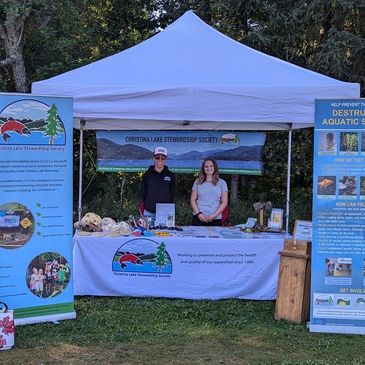
Public outreach helps connect the community with the health and wellbeing of our watershed. By sharing information about conservation, habitat restoration, and sustainable practices, our Society raises awareness and inspires people to take action to protect the environment. You will find us at many public events, including Homecoming an
Public outreach helps connect the community with the health and wellbeing of our watershed. By sharing information about conservation, habitat restoration, and sustainable practices, our Society raises awareness and inspires people to take action to protect the environment. You will find us at many public events, including Homecoming and Big Effort Swim, where our interactive displays engage people of all ages. We also set up our booth at the Texas Creek Boat Launch weekly from May through August, raising awareness and sharing practical tips on preventing the spread of aquatic invasive species.
The Solar Aquatic System also known as the SAS building continues to be a popular attraction. Built in 2010 by Ecological Technologies as a joint project of the Government of Canada and the Regional District of Kootenay Boundary. This innovative, self-sustaining wastewater system is powered entirely by geothermal energy and passive solar
The Solar Aquatic System also known as the SAS building continues to be a popular attraction. Built in 2010 by Ecological Technologies as a joint project of the Government of Canada and the Regional District of Kootenay Boundary. This innovative, self-sustaining wastewater system is powered entirely by geothermal energy and passive solar heating.
The SAS processes all sewage from the Christina Lake Welcome Centre and is purified through aerobic processes that replicate the natural purification functions of streams and wetlands.
If you'd like to learn more, or come for a tour, give us a call!
Incorporated January 2, 2001
1. The name of the society is: Christina Lake Stewardship Society
2. The purpose(s) of the society is (are):
To Promote stewardship practices through:
a) Educational programs
b) Restoration and enhancement projects
c) Promoting community participation
d) Monitoring environmentally sensitive activities
e) Liaison with other organizations, various government agencies, and companies
f) Disseminate information on stewardship activities
g) Help to protect water quality, biodiversity, habitats, ecosystems, and watershed based landscapes
